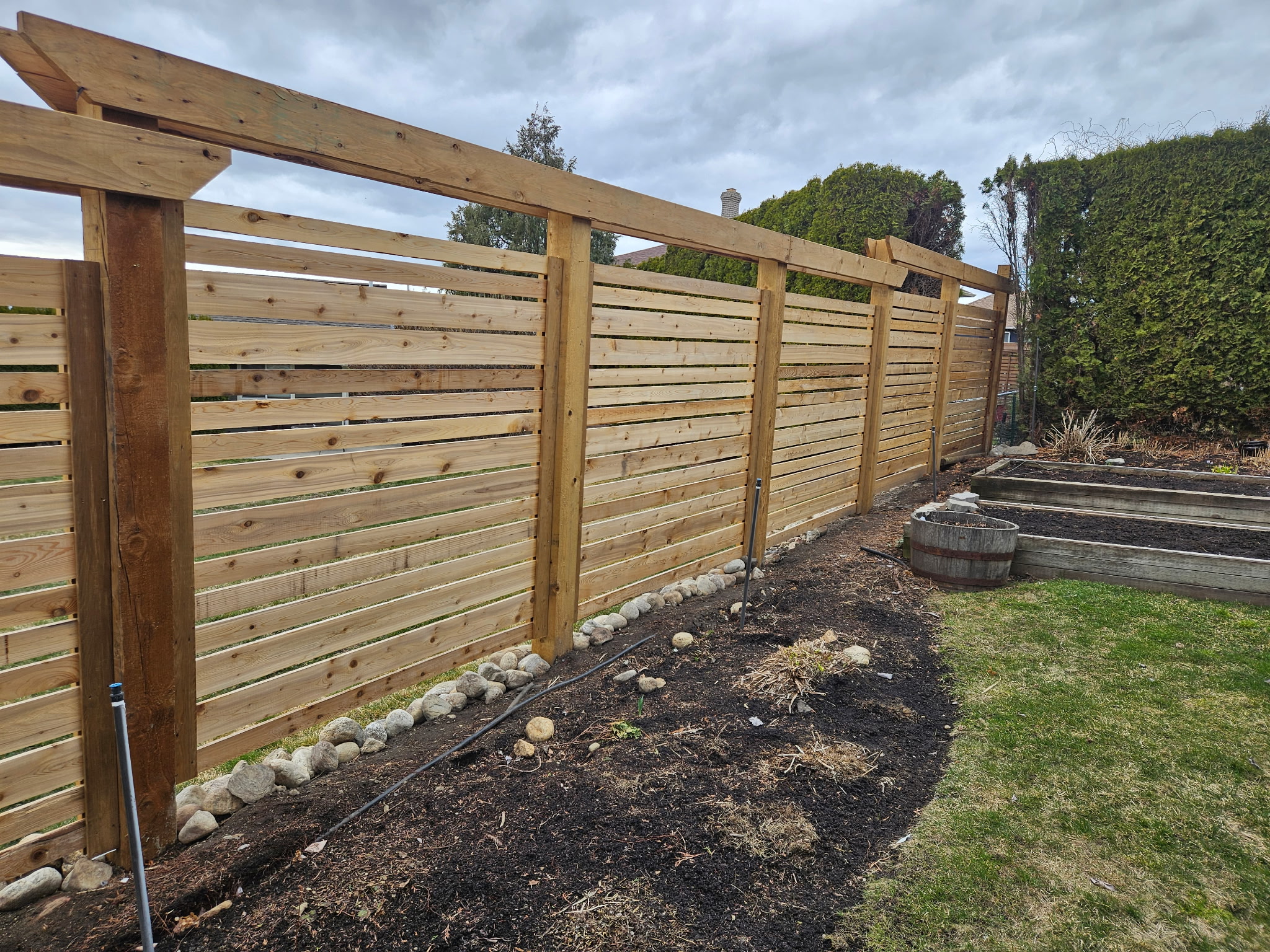
Horizontal cedar
The current favourite. Western red cedar boards run flat between posts for a clean, modern line. Looks best with tighter post spacing so boards can't bow, and with a capped top rail to shed water.
Cedar · 6 ft typical · post caps
Cedar, composite, corrugated metal and chain link fences across the North Okanagan — set below frost, braced properly, and finished so the line still looks true in ten years. Twenty years of it, from our yard in Vernon.
Most Okanagan yards call for one of these. The material changes the look and the budget — the groundwork underneath doesn't change at all.
The current favourite. Western red cedar boards run flat between posts for a clean, modern line. Looks best with tighter post spacing so boards can't bow, and with a capped top rail to shed water.
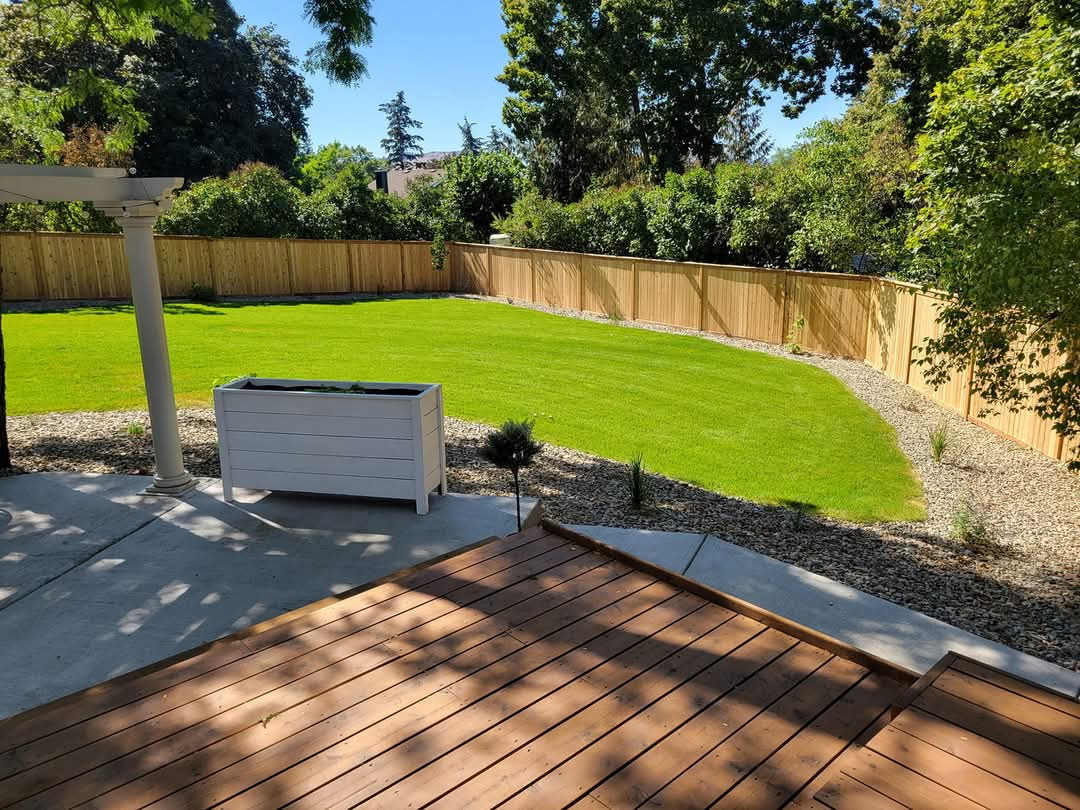
The classic board fence — good-neighbour or standard face, square or dog-ear tops. Cheapest route to full privacy and the easiest to repair board by board years later.
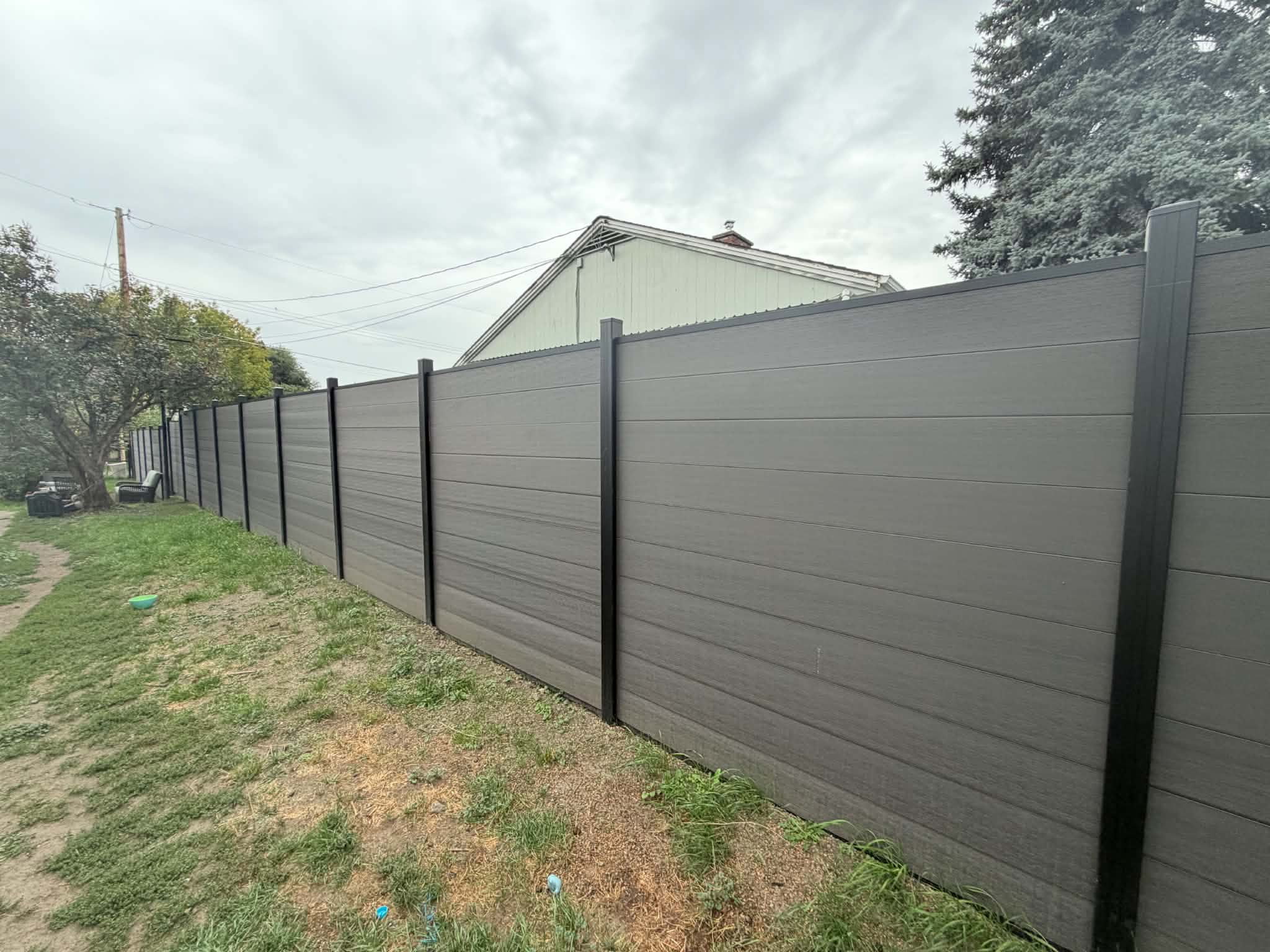
Composite boards in powder-coated aluminum posts. No staining, no greying, no warped boards. Costs more up front and pays it back in the years you don't spend maintaining it.
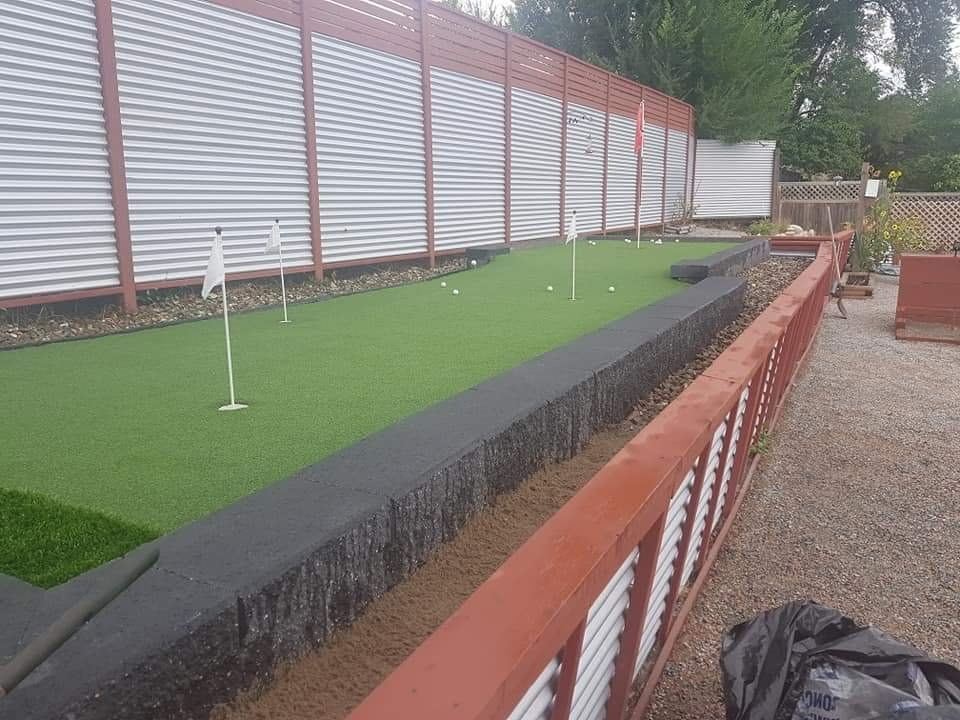
Steel panels in a timber frame. Non-combustible, wind-tight, and a strong fit for wildfire-interface lots backing onto grass or bush. Also the cheapest way to get real height fast.

A galvanized core under a black PVC coat. Against a hedge or a lawn it reads as a thin dark line and then stops registering altogether — which is the whole point. The cheapest way to fence a big yard, a dog run or an acreage without giving up the view or catching the wind. Top rail and tension wire on every run so the mesh stays drum-tight.
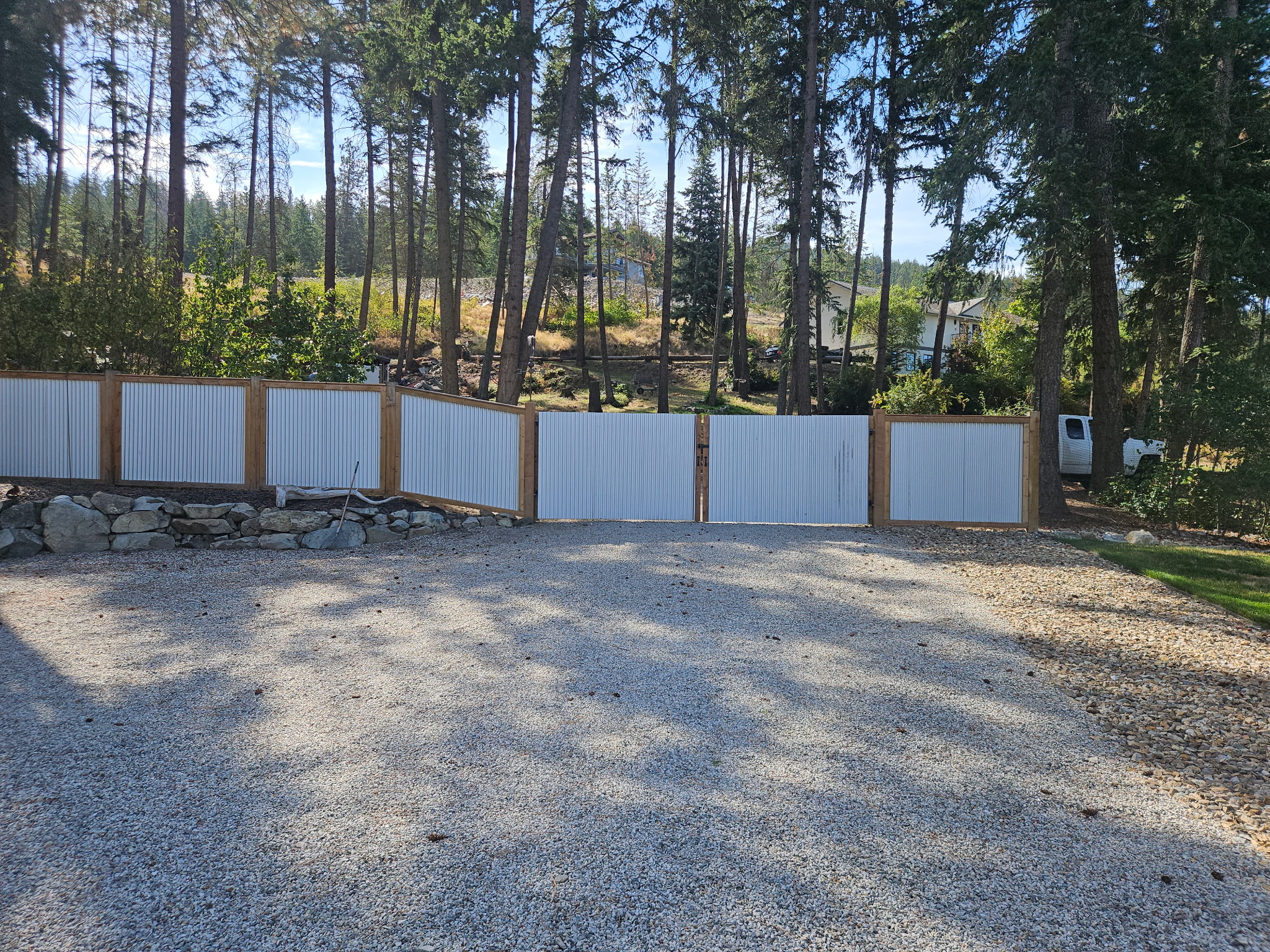
Driveway gates, garden gates and acreage boundary runs. Gates are where cheap fences fail, so ours get braced frames, heavy hinges and a drop rod on doubles.
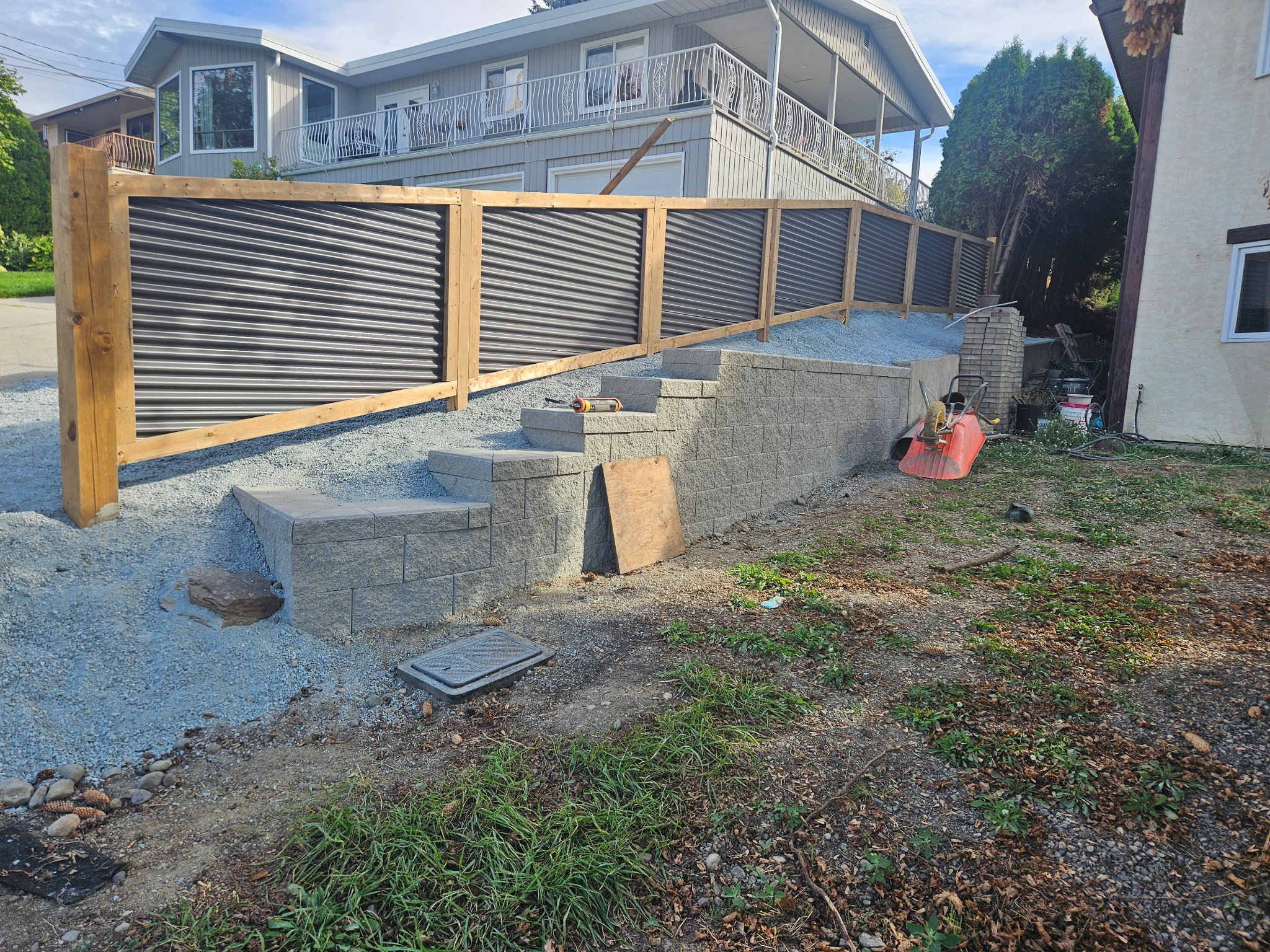
When the fence sits on top of a wall, the wall has to be built for it and the combined height has to clear the bylaw. We build both, so nobody's pointing fingers at the other trade.
Almost every failed fence in the Okanagan failed underground. Frost heave, a post set in soft fill, or a gate hung on a post that was never braced. The visible part is the easy part.
We locate survey pins where they exist, and where they don't we work from the parcel fabric and talk to the neighbour before anything goes in the ground. A fence built 150 mm over the line is a fence you rebuild. If you want to see your own lot lines first, our Yard Measure tool draws them over a satellite view.
BC 1 Call locates go in before the auger comes out — gas, power, telecom. On top of that we hand-check for irrigation mains and low-voltage lighting, which no locate service marks and which run exactly where fence posts want to go.
Okanagan ground freezes deep enough to lift a shallow post, so holes go down past frost — typically 900 mm — and wider at the base than the top. Our soils swing from heavy clay to glacial hardpan to cobble, and each one gets dug differently. Rock gets an auger and a breaker, not a stubborn shovel.
Posts are set plumb on a drainage base so water can't sit around the butt, then collared and braced until they cure. Nothing gets framed on a post that hasn't set. End, corner and gate posts take the real load, so they go deeper and heavier than line posts.
On a slope you either step the fence down in level bays or rack it to follow the ground. Stepped suits formal yards and solid panels; racked suits long rural runs and keeps the gap under the boards even. We'll show you both on site, because they look very different once built.
Cedar's natural tannins eat ordinary fasteners and bleed black streaks down a new fence within a season. Everything structural gets hot-dipped galvanized or coated screws rated for cedar and for the pressure-treated lumber below it.
A gate is the one part of a fence that moves a thousand times a year. Ours get a braced or trussed frame, three heavy hinges rather than two, a latch that still lines up in August when the timber has moved, and a drop rod on double gates.
Spoil hauled out, offcuts gone, the line swept. Old fence and posts removed and disposed of if we're replacing — including the concrete footings, which is the part most quotes quietly leave on your lawn.
A straight comparison, including the parts that don't flatter the expensive options.
| Material | Looks like | Upkeep | Lifespan | Best for |
|---|---|---|---|---|
| Western red cedar | Warm, natural; silvers to grey if left | Stain or oil every 2–4 years to hold the colour; nothing if you like the grey | 15–25 years | Privacy fences where the look matters most |
| Composite + aluminum posts | Uniform, modern, consistent colour | Wash it occasionally. That's the list. | 25+ years | Owners who never want to touch it again |
| Corrugated metal | Industrial, crisp lines, timber-framed | Effectively none | 25+ years | Wildfire interface, wind, full height on a budget |
| Chain link | Open; black vinyl-coated nearly disappears | None | 20+ years | Dogs, deer, pools, acreage, keeping the view |
| Vinyl / PVC | Bright white or tan, very uniform | Wash it; brittle in deep cold if struck | 20+ years | Low-maintenance privacy with a traditional look |
The single most common reason a fence has to come back down. Heights are set by your municipality's zoning bylaw, and they're different at the front of the lot than at the back.
Nobody can quote a fence from a phone call, and anyone who does is guessing. These are the things that genuinely change the number, in roughly the order they matter:
Length. The one everything else multiplies against — and the number people are most often wrong about. Measure it before you ring around.
Material and height. Composite and aluminum sit well above cedar. Going from 5 ft to 6 ft is more than a 20% jump, because the posts and footings grow with it.
Ground conditions. Clay digs fast. Cobble, hardpan and buried concrete do not. Rocky ground is the most common reason a fence quote moves.
Slope. Stepping a fence down a grade means more posts, more cuts and more waste than the same length on the flat.
Removal. Taking out an old fence — especially one with concrete footings — is real labour and real dump fees.
Access. Whether a machine fits through the side yard, or everything is wheelbarrowed in by hand.
Our Yard Measure tool pulls up your property on a satellite view with its surveyed lot lines, and you trace the run you want fenced. It gives you the linear footage in a few taps, tells you which sides face a street, and flags the height limit for your municipality.
It's free, it works on a phone, and you don't have to speak to anyone to use it. Most people arrive at a quote conversation already knowing their number — which makes the whole thing faster.
Where we work
In most Okanagan municipalities a fence within the height limits doesn't need a building permit — but it does have to comply with the zoning bylaw for height, and with sight-line rules on corner lots. A fence on top of a retaining wall, or any wall over 1.2 m, is a different conversation and often does need a permit or a variance. We confirm your lot's rules before we quote.
In BC there's no law forcing a neighbour to share the cost. If the fence sits on the property line it's usually a shared conversation and often a shared bill; if you build entirely on your own side, it's yours — and so is the decision. Either way, we recommend a conversation with the neighbour before the posts go in, and we're happy to be there for it.
Deep enough to sit below the frost line so winter can't lift them, which in this valley generally means around 900 mm. Gate, corner and end posts go deeper and heavier again, because they carry the loads that make a fence lean.
Yes — either stepped down in level bays or racked to follow the grade. Stepping looks more formal and leaves triangular gaps at the bottom; racking follows the ground with an even gap but can't be used with every panel style. We'll show you both on site.
A typical residential run is a few days on site once materials are in — posts set first, then framing and boards after they've cured. Rock, removals and long gates add time. You'll get a timeline with the quote, not after the job starts.
A solid 1.8 m fence works for most Okanagan properties, because deer won't jump into a space they can't see. If you want to keep the view, the alternatives are a higher open fence or an outward-leaning top section. Worth deciding before the posts are set.
Yes, including the concrete footings and the trip to the transfer station. It's quoted as a line item so you can see what it costs rather than finding it buried in the total.
For anything you look at from the house, yes. Galvanized mesh is bright and your eye lands on it; the black vinyl coat drops away against grass, hedging and trees, so you see the yard rather than the fence. The coating also adds a second layer over the galvanizing, which is why black runs tend to outlast plain ones. The premium is small next to the cost of the posts and the labour, and it is the single cheapest thing you can do to make a chain link fence look deliberate.
Non-combustible. On wildfire-interface lots, FireSmart guidance is to avoid combustible fencing attached to the house — corrugated metal or chain link within that zone, with cedar further out, is a sensible compromise that still looks good.
Tell us the run, the look you're after and roughly when — we'll come and walk it with you. Free quote, no sales pitch, and a straight answer about what your bylaw allows.